The Material · Craftsmanship · Glass Jewelry
At Cajal, everything begins with fire and a thin rod of glass. Not just any glass — borosilicate, the same resilient material trusted by laboratories and astronomers, reimagined into jewelry you can wear every day. This is the story of our main material: what it is, why it matters, and the slow, skilled craft of shaping it into pieces small enough to live on your ear, your finger, or against your skin.

What Is Borosilicate Glass?
Borosilicate glass is a type of glass made by adding boron trioxide to the traditional mix of silica sand and soda. That single ingredient changes everything. Where ordinary soda-lime glass (think drinking cups and window panes) expands and cracks under sudden temperature changes, borosilicate barely moves. It has a very low coefficient of thermal expansion, which is the technical way of saying it can take heat, cold and shock that would shatter regular glass.
If you've ever poured boiling water into a lab beaker or used a classic glass measuring jug in the oven, you've already met it. Invented in the late 19th century by German glassmaker Otto Schott, borosilicate became the gold standard wherever glass needs to be both transparent and tough.
Why Makers Love It
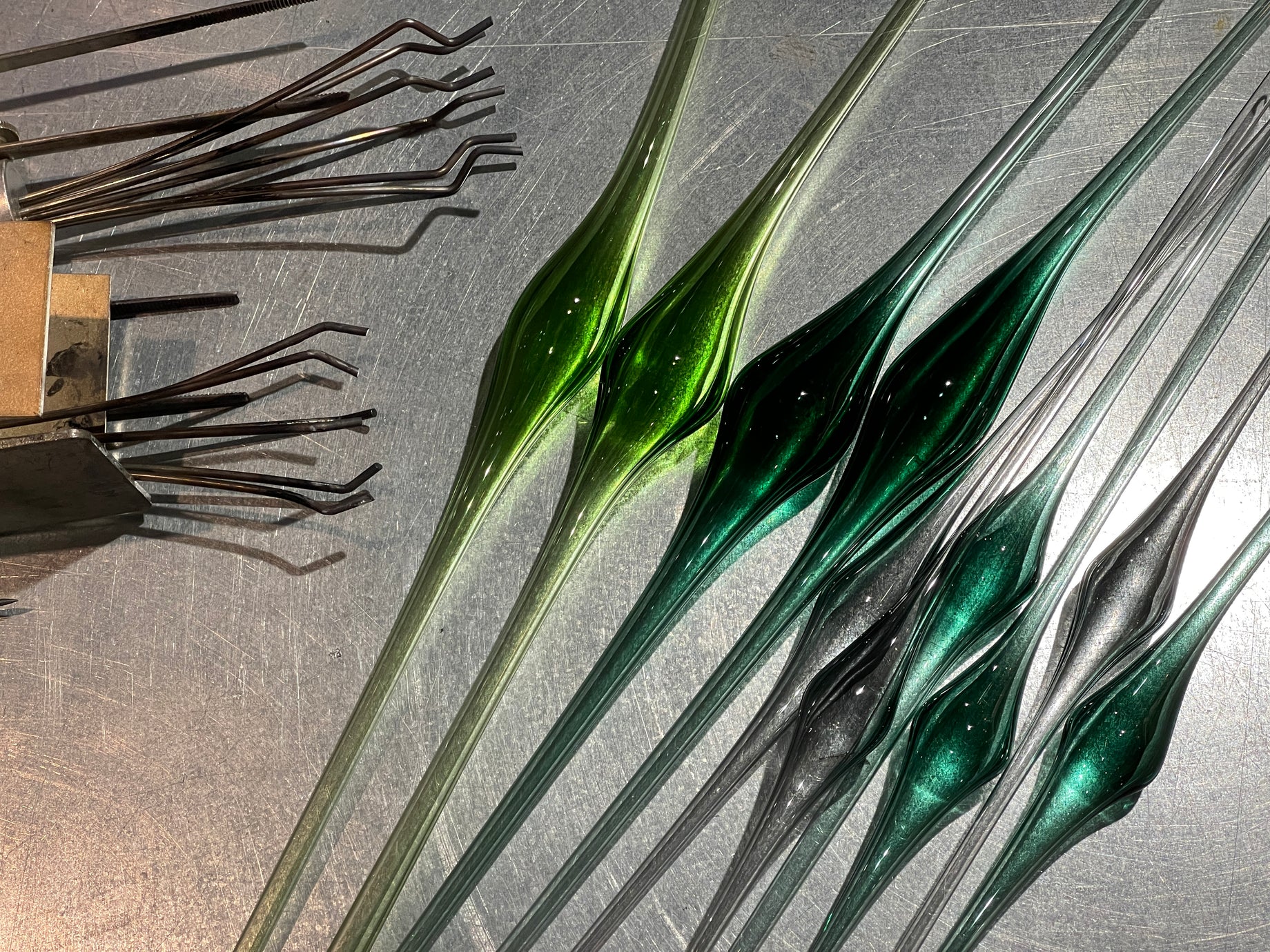
For an artist working at the torch, those same properties are a gift. Because borosilicate tolerates extreme heat, it can be worked in an open flame for long stretches without failing — which is exactly the patience that detailed, sculptural jewelry demands. It also holds color beautifully, letting deep blues, ambers and translucent pastels glow without clouding.
What Is Borosilicate Glassware? Common Uses Beyond Jewelry
Before it ever became a jewel, borosilicate earned its reputation in demanding places. Borosilicate glassware is the clear, heat-resistant glass you'll find in laboratory beakers and flasks, kitchen bakeware and French-press carafes, measuring jugs, pharmaceutical vials, high-end lighting, and even the mirror of large astronomical telescopes. When something has to be clear, stable and trustworthy, this is the glass engineers reach for. At Cajal, we simply take that same engineering-grade resilience and turn it into something you can wear.
The same family of glass behind telescope mirrors and lab equipment is what gives Cajal jewelry its lasting strength.
Borosilicate Glass Jewelry
Turning an industrial-strength material into delicate adornment is its own art form. Borosilicate jewelry sits at the meeting point of science and sculpture: pieces that are surprisingly durable, feather-light to wear, and impossible to replicate exactly. Because the glass is shaped by hand in a live flame — never poured into a mold — every earring, ring and necklace carries tiny, intentional variations. No two are ever truly identical.

Below, a closer look at the main families of borosilicate glass jewelry and what makes each one a small technical challenge.
Borosilicate Glass Earrings
Earrings are where glass really comes alive, because they move and catch the light with you. Working at the torch, the artist pulls and shapes molten glass into drops, hoops and sculptural forms, then carefully anneals (slowly cools) each piece so it won't carry internal stress. The hardest part? Symmetry. A matching pair has to be balanced in size, weight and color while still being made one at a time, entirely by hand.
From sculptural drops to everyday hoops, our glass earrings are designed to feel light and look like art.

Borosilicate Glass Rings
Rings are arguably the most demanding glass pieces of all. The band has to be perfectly round, smooth on the inside, and sized to fit a real finger — all formed in a flame where the glass is constantly trying to sag and shift. The maker rotates the piece continuously to keep the shape even, judging the temperature by color and feel alone. A few seconds too long, and the form is lost. It's craftsmanship measured in heartbeats.
Statement glass rings that feel weightless on the hand — each shaped and sized by hand.

Borosilicate Glass Necklaces
Necklaces let the glass become a true focal point. Pendants can be sculpted with more volume and drama, with the artist building up layers of clear and colored glass to create depth that seems to glow from within. The challenge here is consistency across a larger form: keeping the whole piece evenly heated so it cools without cracking, and balancing the weight so it hangs exactly right against the body.
From subtle pendants to expressive statement pieces, our necklaces turn glass into wearable art.

Beyond the Classics: Hairpieces & More
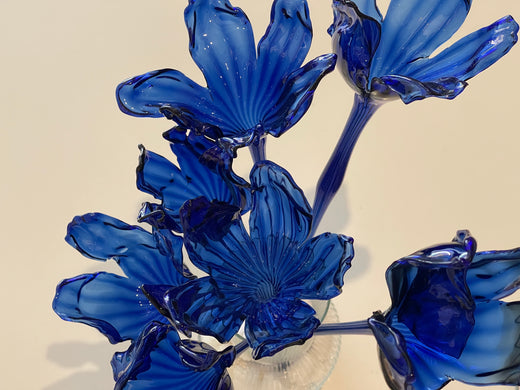
The same techniques extend to hairpieces and homeware — anywhere a sculptural, light-catching detail can elevate the everyday. Because each form is built freehand, the range of what borosilicate can become is limited only by the maker's imagination. Discover the full range across hairpieces and our wider jewelry collection.
The Craftsmanship Behind Every Piece
At Cajal, we refrain from using molds. Every piece is shaped individually at the flame, which means hours of meticulous attention go into forms small enough to sit on a fingertip. This is the part you can't see when you slip on an earring — the quiet, demanding hours that make it exist at all.

Flameworking: Sculpting With Fire
The technique is called flameworking (or lampworking): glass rods are melted in a focused torch flame reaching well over 1,000°C, then shaped while glowing and molten. There is no undo. The artist reads the glass in real time — its color tells them the temperature, its movement tells them the timing — and works with it rather than against it. As we like to say, fire and glass set the rhythm; the maker just learns to follow.
Why Small Is So Hard
It's tempting to assume tiny means easy. The opposite is true. On a small scale, heat travels fast and unevenly, so a piece can collapse, overheat or crack in an instant. Detail work — a fine twist, a precise curve, two earrings that truly match — leaves no margin for error. The smaller and more refined the piece, the more control, breath and patience it demands from the hand that makes it.
Annealing: The Patient Finish
After shaping, each piece is annealed — cooled slowly and deliberately in a kiln so the glass releases its internal stress. Skip this step and even a beautiful piece will be fragile and prone to cracking. It's the unglamorous, invisible stage that gives borosilicate jewelry its real, everyday durability.
"In the realm of glass, we've discovered a profound resemblance to ourselves as human beings; the boundless ability to transform, alongside the fragility and care we require." Read more on our About page and our take on sustainability & craftsmanship.
Art, Design & the Maker's Hand
Beyond the technical mastery, there's intention. Every Cajal piece is designed before it's made — a study in color, proportion and movement. Because we work to order with no stock and no waste, each creation is a deliberate act rather than a mass-produced object. What you wear isn't just an accessory; it's a small, signed artwork in glass.
Caring for Borosilicate Glass Jewelry: Do's & Don'ts
Borosilicate is tough for glass, but it's still glass — treat it with a little awareness and it will last for years. Here's the short version.
✓ Do
- Store pieces in their pouch or box, separated from hard objects and keys.
- Put jewelry on last, after makeup, perfume and hairspray.
- Clean gently with a soft, slightly damp cloth.
- Handle rings and pendants by the band or chain, not the delicate detail.
- Take pieces off before sleep, sport or heavy manual tasks.
✕ Don't
- Drop pieces onto tile, stone or other hard surfaces.
- Use abrasive cleaners, solvents or ultrasonic machines.
- Toss earrings loose into a bag where they can knock together.
- Force a ring on or off — choose the correct size instead.
- Expose pieces to sudden, extreme impact (resistant isn't the same as indestructible).
Borosilicate Glass Jewelry: FAQ
Is borosilicate glass breakable?
It's significantly more durable and shock-resistant than ordinary glass, which is why it's used in labs and bakeware. That said, it is still glass: it can chip or break under a hard, direct impact such as a fall onto tile or stone. With normal everyday wear and a little care, it holds up beautifully.
Is borosilicate glass jewelry waterproof?
Yes. The glass itself is non-porous and completely unaffected by water, so a splash, rain or washing your hands won't harm it. We do recommend removing pieces before swimming or showering — not because of the glass, but to protect any metal findings (earring posts, clasps) and to avoid accidental knocks.
Is it eco-friendly and sustainable?
It's one of borosilicate's strongest points. The glass is recyclable and reusable, and at Cajal we work made-to-order with no stock and no waste. Each piece is created only when it's needed, which keeps our footprint deliberately small. Read more in our sustainability journal entry.
Is borosilicate glass hypoallergenic?
The glass itself is chemically inert and doesn't react with skin, making it a great option for sensitive wearers. If you have metal sensitivities, just check the findings (such as earring posts), since those are the parts that touch your skin most directly.
Is glass jewelry heavy to wear?
Not at all — most people are surprised by how light it is. Borosilicate pieces are designed to feel comfortable for all-day wear, even when the shapes look bold or sculptural.
Why is each piece slightly different?
Because we never use molds. Every piece is shaped by hand in a live flame, so tiny variations in form and color are part of its nature — and proof that what you own is genuinely one-of-a-kind.
How should I clean my glass jewelry?
Wipe gently with a soft, slightly damp cloth and dry it. Avoid abrasive cleaners, harsh chemicals and ultrasonic cleaners. Store each piece separately so it doesn't scratch or knock against other items.
Can the colors fade over time?
No. The color in borosilicate glass is built into the material itself during making, not painted or coated on top. It won't fade, peel or wash away with normal wear.